/PRZWT/After finishing writing, can the ink dry up faster?
The pen dropped to the ground. Can writing still be done smoothly?
These common problems in writing are not easy to solve. A simple pen contains a lot of complexity. Making a pen may seem simple, but there are actually many intricate details involved. Just the manufacturing of the pen tip alone involves more than 20 processes, and the processing accuracy and difficulty are comparable to those of the components of a precision watch.
Ten years ago, there was a topic that sparked intense discussion: China is a major producer of writing instruments, but the round balls on the pens have long relied on imports. China's manufacturing capabilities enabled the high-speed operation of high-speed railways and the submersion of the "Jiaolong" deep-sea vehicle, yet why couldn't it produce a good-quality pen?
Starting as a retailer, Chenguang Stationery set its sights on "producing a good pen made by Chinese people". "After decades of industry accumulation, we have established a relatively complete research and development mechanism and gradually overcame the technical challenges in manufacturing the pen tips of high-performance ballpoint pens," said Chen Huxiong, the president of Chenguang Stationery. "The goal of producing a useful ballpoint pen has already been achieved, but this is a continuous path of technological research and development. The pursuit of 'good' by consumers will never end, and we have been constantly advancing along with the tide of the times."
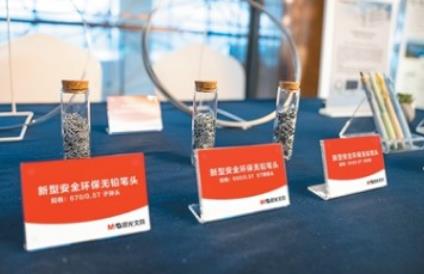
In recent years, countries around the world have been increasingly demanding higher standards for the environmental safety and quality of writing instruments. In response to this, lead-free pencils have emerged.
"We worked together with the technical team of Taiyuan Iron and Steel Company to establish a research and development team, and jointly broke through the core material technology bottlenecks in the pen-making industry," said Yao Hongjun, vice president and senior engineer of the Technical Center of Chenguang Stationery.
In the past, breaking through the manufacturing difficulties of high-performance ballpoint pen tips in China was accomplished through the collaboration between Chenguang Stationery and Taigang Steel. This time, the old partners have joined hands again. Taigang Steel is focusing on the smelting technology of lead-free and easy-to-cut stainless steel wire for pen tips, while Chenguang Stationery is responsible for the innovation of new pen tips, quick-drying pigment-based neutral ink, and self-adjusting sealants, as well as the industrialization of the entire pen.
“A good writing pen is a system engineering project where the pen tip, ink, and sealant are deeply matched,” said Yao Hongjun. “We overcame technical barriers and innovatively developed three core materials: lead-free, environmentally friendly, easy-to-cut stainless steel pen tips, quick-drying pigment-based neutral ink, and impact-resistant, self-adjusting sealant. Through hundreds of precise performance tests and repeated optimization of various physical and chemical parameters, we achieved the compatibility of ink supply, ink flow rheology, and sealant self-adjustment in the pen tip. Finally, we created high-quality neutral ballpoint pens, with all dimensions of comprehensive performance reaching the international advanced level.”
Chenguang Stationery and Taiyuan Iron and Steel jointly tackled the development of new environmentally friendly materials for neutral ballpoint pens and achieved large-scale industrial application. The related achievements were selected as advanced scientific and technological innovation achievements in the light industry sector during the "14th Five-Year Plan" period in November last year.
"Chenguang Stationery invests over 100 million yuan annually in research and development and product innovation, and holds over 1,400 patents. We focus on doing this small thing well, and adhere to the principle of 'digging one meter wide to a depth of ten thousand meters'." Chen Huxiong said. "In the future, we will continue to work on environmental protection technologies, using green manufacturing to promote the low-carbon transformation of the production end, controlling carbon emissions throughout the entire process, deeply integrating the concept of sustainability into the supply chain and the entire product life cycle management, and leading the sustainable development of the stationery industry with small innovations."